
Polypropylene burns readily in ordinary air, so choosing a flame-retardant chemical requires more than adding a small smoke suppressant to the resin. You will be able to match the PP grade, additive chemistry, processing conditions and finished-part tests before requesting a trial from an Ahmedabad supplier.
Key takeaways
- Prioritise PP parts exposed to ignition, flame spread or hazardous dripping.
- Compare reactive, additive and intumescent chemistries by compatibility and processing needs.
- Request resin grade, loading, target rating and compounding conditions before selecting an additive.
- Verify finished parts with UL 94, LOI, glow-wire and application-specific tests.
Which polypropylene components and resin grades need flame retardancy?
Unfilled polypropylene has a limiting oxygen index (LOI) of approximately 18%, so it burns readily in ordinary air. Flame-retardant targets include injection-moulded electrical enclosures, appliance housings, automotive trim, cable components, industrial covers and PP fibres where ignition, flame spread or dripping creates a service risk.
Resin grade changes the starting point:
| PP grade | What changes | Practical implication |
|---|---|---|
| PP homopolymer | Higher stiffness and heat resistance | Check impact retention after additive loading |
| PP random copolymer | Better clarity and low-temperature toughness | Confirm additive compatibility and crystallisation effects |
| Impact copolymer PP | Rubber phase improves impact strength | Avoid a formulation that embrittles the finished part |
| PP filled grade | Mineral or glass filler changes flow, density and burning | Requalify at the actual filler content |
| Recycled PP | Previous heat history and contamination vary | Test every approved regrind source and blend ratio |
Define the finished-part requirement before selecting a chemical. UL 94 and IEC 60695-11-10 classify specified specimens, not complete products; an enclosure or appliance may also need glow-wire, hot-wire ignition, abnormal-heat, tracking or end-product tests. UL 94 V-0 depends on thickness: passing at 3.2 mm does not prove passing at 1.5 or 0.8 mm.
Test the thinnest production wall, because it contains less flame-retardant mass and heats faster.
How do flame-retardant chemistries work in polypropylene?
Flame retardants protect polypropylene through four routes: gas-phase inhibition, condensed-phase char, dilution of fuel, and endothermic cooling. The best choice depends on processing temperature, target thickness, loading tolerance and whether smoke is also controlled.
| Option | Mechanism | Trade-off |
|---|---|---|
| Halogen-free flame retardant PP | Intumescent char blocks heat and fuel; ammonium polyphosphate supplies acid, while pentaerythritol and melamine build and expand the carbonaceous layer. | This intumescent polypropylene system often needs high total loading and careful dispersion, which can lower flow, impact strength and surface quality. |
| Aluminium hydroxide | Releases water for endothermic cooling and fuel dilution. | Decomposes around 180–220 °C, overlapping conventional PP processing temperatures, so it is usually a poor primary choice. |
| Magnesium hydroxide | Releases water at a higher decomposition temperature, around 330–350 °C. | It needs higher loading and can reduce impact strength, melt flow and processability. |
| Zinc borate | Promotes a coherent char and suppresses smoke as a zinc borate polypropylene synergist. | Treat it as a synergist or package amplifier, not a stand-alone solution; the primary system controls the final rating. |
| Antimony trioxide | Enhances gas-phase inhibition with a compatible halogen system. | It is not an effective stand-alone PP flame retardant and increases density and smoke-toxicity scrutiny. |
The pentaerythritol melamine package works in the condensed phase, while halogen systems with antimony trioxide inhibit flame radicals in the gas phase. A formulation can pass UL 94 and still generate substantial smoke, so verify smoke separately with ISO 5659-2 or cone-calorimeter smoke measurements.
What formulation and compounding information should you request?
A supplier’s “recommended addition” is not a PP flame retardant dosage. Request a written starting dosage, formulation window and target specimen thickness; then screen at least three loading levels. High mineral or intumescent loading can lower MFR, tensile elongation and impact strength while increasing density, screw torque and mould wear.
1. Ask for the active composition, phosphorus content, particle-size distribution, bulk density, moisture, decomposition temperature, shelf life, packaging and PP compatibility data. For APP, require APP moisture resistance information: conventional grades can absorb moisture, hydrolyse or migrate. Encapsulated APP can improve water resistance, but it costs more and can change viscosity and dispersion.
2. Define the compounding trial in writing: premixing sequence, feeder location, screw configuration, residence time, melt temperature, thermal-stability limit, distributive-dispersion target and whether direct addition or a masterbatch is preferred. Require drying temperature and time, plus the permitted regrind percentage. Excessive heat, poor drying or long residence time can degrade APP and create agglomerates.
3. For a masterbatch, specify the flame retardant masterbatch carrier, active loading and let-down ratio. A polyethylene carrier can alter PP dispersion and ignition behaviour. Test the final PP compound, not only the masterbatch.
Measure post-compounding MFR at every loading level, then compare density, torque, tensile elongation, impact strength and mould wear. Approve a formulation only after testing the intended thickness and confirming that processing history has not erased the fire-performance target.
How can an Ahmedabad buyer qualify a flame-retardant chemical supplier?
Treat the search phrase flame retardant chemical supplier Ahmedabad as a starting point, not proof of capability. Request a current PP technical data sheet, safety data sheet, retained batch sample, certificate of analysis, lot number, storage conditions and a written classification: halogenated, phosphorus-based, nitrogen-based, mineral-based or intumescent.
Ask the supplier to document the exact PP grades tested, addition range, processing temperature and specimen thickness behind each claim. A broad plastics statement does not prove performance in homopolymer, impact-copolymer, filled or recycled PP. Niknam Chemicals Pvt.
Ltd can be approached for this information; a purchase decision must rest on PP-specific evidence, not location or a product label.
Use one comparison sheet for every supplier:
| Measure | Record | Why it matters |
|---|---|---|
| UL 94 | V-0, V-1 or V-2 at intended thickness | A 3.2 mm result does not prove 1.5 mm performance |
| LOI | Tested value | Indicates oxygen concentration needed to sustain burning |
| Cone calorimetry | Peak and total heat release | Shows fire behaviour that UL 94 does not |
| Smoke | Smoke yield or ISO 5659-2 result | Separates smoke control from flame classification |
| Ash and density | Values after compounding | Exposes loading and residue differences |
| MFR | Post-compounding result | Reveals flow loss from additive loading |
| Impact retention | Before-and-after values | Identifies brittle formulations |
Require a lab-scale or production-relevant trial, recording processing settings, dispersion, mould filling and regrind. Ask any PP flame retardant manufacturer Gujarat buyers assess to provide this same evidence before approval.
Related product
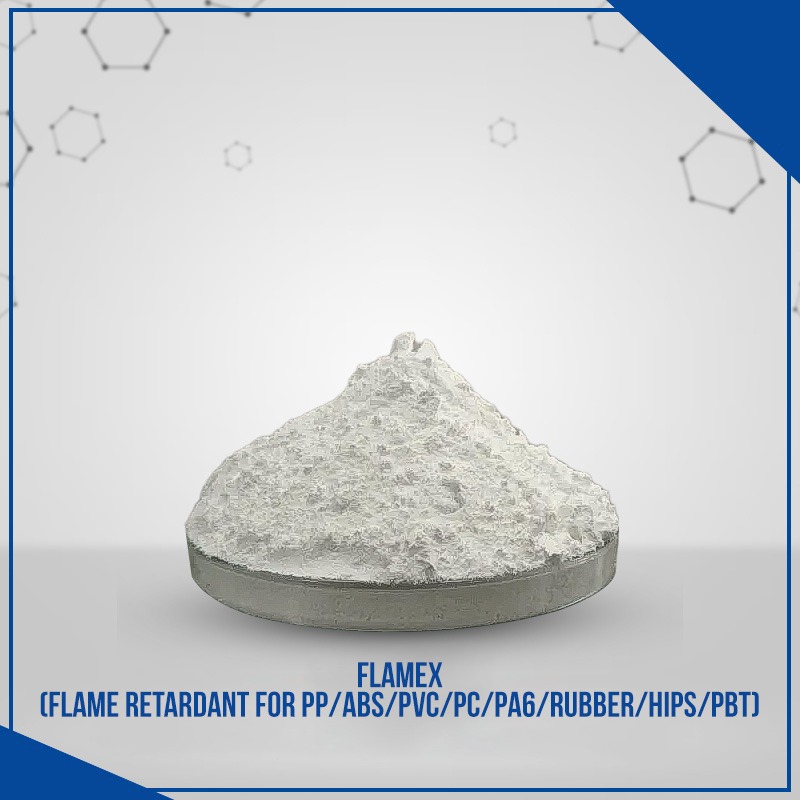 | flame retardant additives Flamex ( Flame Retardant for PP ABS PVC PC PA6 RUBBER HIPS PBT ) FLAMEX ( One Pack Flame Retardant ) manufactured by our company is widely used in PP,PA, PE,PC ,PC/ABS, PVC , Rubber ,PBT, PET, XPS, EPS, PU ,PVC,... View product → |
Which tests prove that a flame-retardant PP component is fit for service?
A component is fit for service only after the compounded PP passes material, fire, smoke and processing-history checks at its intended thickness. Mould test specimens using the production formulation, then condition them under the documented temperature, humidity and drying schedule; moisture and thermal history can change the result.
Test vertical burning under UL 94 at the actual thickness, reporting V-0, V-1 or V-2 and the conditioning state. IEC 60695-11-10 provides the corresponding small-specimen method. A UL 94 V-0 polypropylene result does not prove acceptable heat release, smoke or toxic-gas performance.
| Test | What it measures | What it cannot replace |
|---|---|---|
| Cone calorimeter PP | Peak heat-release rate, total heat release and effective heat of combustion | Finished-part fire testing |
| ISO 5659-2 smoke testing | Smoke generation under a defined radiant heat and flame condition | UL 94 classification |
| Post-process testing | MFR, density, tensile strength, elongation, impact strength and weld-line performance | Resin supplier data |
| Production review | Agglomerates, specimen variation, APP degradation and mould wear | Laboratory screening alone |
Repeat the fire and mechanical tests after the intended number of heat histories and regrind cycles. Record screw torque and inspect mould wear when mineral or intumescent loading is high.
For electrical or electronic parts, identify the applicable Indian product standard and restricted-substance documents. A “RoHS compliant” declaration does not replace checking the E-Waste (Management) Rules, 2022 obligations or the exact end-use compliance route.
Frequently asked questions
Which polypropylene components need flame retardancy?
Electrical enclosures, appliance housings, automotive trim, cable components, industrial covers and PP fibres need review when ignition, flame spread or dripping creates a service risk.
How do flame-retardant chemicals work in polypropylene?
They interrupt combustion through mechanisms such as gas-phase radical quenching, condensed-phase char formation, intumescence or smoke suppression. The suitable mechanism depends on the PP grade, processing conditions and required performance.
What formulation information should you request?
Request the PP resin grade, filler and pigment package, additive loading, target fire rating, processing temperature, residence time, screw configuration and any requirements for colour, impact strength, migration or surface finish.
How can an Ahmedabad buyer qualify a flame-retardant supplier?
Check technical data sheets, safety data sheets, batch traceability, certificate-of-analysis samples, application support, storage guidance and the supplier’s ability to provide repeatable material quality.
Which tests prove a flame-retardant PP component is fit for service?
Use the test method named by the application, which can include UL 94, limiting oxygen index, glow-wire testing, cone calorimetry, smoke measurements and mechanical or electrical tests on finished parts.