
The right flame-retardant package depends on the polymer’s melt temperature, wall thickness, fire test, smoke requirement and acceptable loss of mechanical performance. By the end, you will be able to shortlist additive families for common polymers, specify a trial formulation, and ask for the test evidence needed before approving a compound.
Key takeaways
- Match ATH or magnesium hydroxide to resin processing temperature and residence time.
- Set loading, shear and dispersion checks before running the first formulation trial.
- Measure fire performance alongside strength, impact, appearance and smoke results.
- Request traceable fire, smoke, substance and batch documentation from suppliers.
Match the additive family to the polymer and its processing window
The best polymer-specific flame retardant selection starts with melt temperature, residence time and required wall thickness. Do not transfer an additive package from one resin to another: ATH can dehydrate near 180–220°C, while magnesium hydroxide remains usable closer to 300–350°C, subject to residence time and shear.
| Polymer | Best starting additive family | Processing-window watchpoint |
|---|---|---|
| PP | Phosphorus-nitrogen intumescent; brominated system with synergist for thin walls | Check char expansion, dispersion and impact loss |
| PE | Magnesium hydroxide, ATH for lower-temperature grades, or an intumescent | Match decomposition temperature to the melt |
| PVC | Zinc borate or molybdate smoke package; antimony trioxide with halogenated chemistry when needed | PVC supplies chlorine; assess smoke, corrosion and electrical effects |
| ABS | Brominated flame retardant with antimony trioxide synergist | Poor dispersion causes surface defects and sharp UL 94 loss |
| PA6 | Organophosphorus or melamine-phosphinate system | Dry the polymer and additive; moisture can reduce strength and processing stability |
| PBT | Metal phosphinate or phosphorus-nitrogen system | Control hydrolysis and residence time |
| PET | Phosphorus-based reactive or additive system | Use high-temperature-stable chemistry; avoid ATH as the sole choice |
| Rubber | ATH or magnesium hydroxide; halogenated-synergist package for demanding grades | Preserve cure chemistry, elongation and density |
| HIPS | Brominated additive with antimony trioxide | Verify impact retention and thin-wall performance |
| Polyurethane | Melamine, phosphorus or mineral package selected for flexible or rigid foam | Protect cell structure and control viscosity |
| XPS | Foam-compatible polymeric brominated system | Check cell size, extrusion stability and regulatory status |
| EPS | Expandable-bead-compatible brominated or phosphorus system | Confirm bead expansion, ageing and smoke behaviour |
Antimony trioxide is a synergist, not a stand-alone solution. Treat smoke suppressant selection separately: zinc, molybdate, metal hydroxide and phosphorus packages can alter colour, resistivity and density, so test the finished formulation.
Use loading, temperature and dispersion limits to design the first trial
Set the first trial by total additive loading, melt temperature, residence time and dispersion method—not by the supplier’s flame rating alone. For polyolefin formulations using ATH or magnesium hydroxide, screen roughly 40–65 weight percentage in the finished compound; the mineral load can improve flame performance while sharply reducing elongation, impact strength and flow.
1. Define the dosage basis before weighing. Record both phr and weight percentage: 50 phr means 50 parts additive per 100 parts polymer, which equals 33.3% of the combined polymer-additive mass. Do not compare a phr figure with a weight percentage without converting it.
2. Run a loading ladder rather than one formulation. A practical mineral screen is 40%, 50% and 60% total ATH or magnesium hydroxide, followed by a mechanical and fire test at each level. For an intumescent package, set separate levels for the acid, carbon and blowing sources; changing one component can weaken char formation.
3. Set the melt-temperature ceiling from decomposition data. ATH begins dehydration around 180–220°C, so avoid prolonged exposure near that range. Magnesium hydroxide decomposes around 300–350°C and suits higher-temperature processing, but confirm the polymer’s melt temperature, residence time and shear history.
4. Control moisture and dispersion. Dry hygroscopic polymers and intumescent ingredients to the resin supplier’s specified moisture limit, feed powders through a well-calibrated gravimetric feeder, and use enough shear to break agglomerates without extending residence time. Inspect pellet cross-sections for mineral clusters before moulding.
Record screw speed, barrel-zone temperatures, torque, pressure and residence time for every trial; otherwise a passing result cannot be reproduced.
Balance fire performance against strength, impact, appearance and smoke
Do not choose the highest UL 94 rating if it causes a brittle, heavy or visibly poor part. Compare every candidate with the unfilled polymer at the same moulding conditions and measure the complete set of mechanical properties and appearance criteria.
| Route | Fire and smoke result | Mechanical and physical cost | Appearance and processing risk |
|---|---|---|---|
| Mineral hydroxides | ATH or magnesium hydroxide can suppress flame and smoke through endothermic water release | Strong performance can require roughly 40–65 wt.%, raising density and reducing tensile strength, elongation and impact resistance; flexural modulus often rises | Poor dispersion produces rough surface finish, voids and processing difficulty |
| Intumescent system | An acid, carbon and blowing package forms an insulating char; assess smoke suppression and char after ageing | Lower mineral loading can preserve impact and elongation better than ATH-only designs | Moisture, shear and imbalance can cause swelling, colour change and uneven surfaces |
| Halogenated package with antimony trioxide | Efficient flame inhibition at low loading; antimony trioxide is a synergist, not a stand-alone retardant | Replacing or reducing the synergist can sharply reduce thin-wall performance | Check colour, pigment interaction, corrosion and smoke separately |
| Smoke suppressant package | Zinc, molybdate, metal hydroxide or selected phosphorus compounds can reduce visible smoke in specific polymers | Gains in smoke suppression can alter resistivity, density or strength | Confirm the finished colour and surface finish; additive identity alone proves nothing |
Use tensile strength, elongation, notched impact, flexural modulus and density as release data. Run smoke testing on the finished formulation; UL 94 does not measure smoke density or toxicity. Reject a formulation when its fire gain does not justify the lost impact, colour or surface quality.
Specify the exact fire, smoke and substance evidence you need
A passing result proves fit only when the test uses the intended polymer, thickness, colour and finished construction. Request the laboratory report, not a certificate that names only the additive.
| Test or application | Specimen evidence | What the result proves |
|---|---|---|
| UL 94 V-0 | 125 × 13 mm bars at the specified thickness and colour | Vertical burning classification; a pass at 3.2 mm does not prove a 0.8 mm enclosure will pass |
| ASTM E84 | Finished panel or assembly, 20 in wide by 24 ft long, with mounting details | Flame spread and smoke-developed index for a surface product; not a substitute for UL 94 |
| IEC 60695-11-10 | Polymer bars at the declared thickness, conditioning and colour | Horizontal or vertical burning behaviour under the stated method |
| IEC 60332-1-2 | One complete insulated wire or cable, 600 mm long, tested vertically | Single-cable flame propagation; bundled cables require the applicable IEC 60332-3 method |
For smoke, ask for the finished formulation’s ASTM E662 specific optical density or ISO 5659-2 smoke-density report, including heat mode, specimen thickness and conditioning. For railway interiors, demand the exact EN 45545-2 hazard level, vehicle operation category, installation category, R requirement, smoke and toxicity evidence; UL 94 cannot replace it.
Request these compliance records before approval:
- EU RoHS declaration covering every homogeneous material, including PBB and PBDE below 0.1% by weight where applicable
- REACH status for each substance, including registration, restriction, authorisation and article-communication duties
- SDS, composition or substance-declaration data, batch traceability and laboratory accreditation scope
- Finished-product reports linking the tested formulation to its additive lot, loading, processing history and specimen dimensions
Turn an Ahmedabad supplier discussion into a controlled formulation decision
Do not approve a catalogue name for production. Approve a documented match between the additive, your polymer, your process and the finished article.
1. Ask the Ahmedabad flame retardant supplier for a current technical data sheet showing recommended loading in weight percent or phr, density, particle size, moisture, decomposition or activation temperature, compatible polymers, processing-temperature limits and maximum residence time. Require polymer-specific data rather than a claim that one grade suits every resin.
2. Request an SDS identifying hazards, handling controls, transport classification and composition disclosures. Add a certificate of analysis for the proposed batch and written evidence of batch consistency, including limits for moisture, particle size and active content.
3. Ask for processing instructions: drying temperature and time, feeder sequence, shear limits, dispersion method and whether the additive reacts with pigments, plasticisers, stabilisers or glass fibre. For an intumescent package, request evidence after heat ageing, not only the initial char result.
4. Require smoke data from the finished formulation. A smoke suppressant can alter colour, electrical resistivity, corrosion, density and impact strength, so an additive identity alone proves nothing.
5. Obtain a RoHS declaration covering PBB and PBDE restrictions in homogeneous materials, plus a REACH statement for the exact substances, concentrations and supply chain. Neither document replaces fire testing.
6. Give Niknam Chemicals Pvt. Ltd the target polymer, grade, wall thickness, process temperature and test specification, then request trial quantities and agreed acceptance limits before ordering production material. Reject any proposal that cannot link its data to your formulation and batch records.
Related products
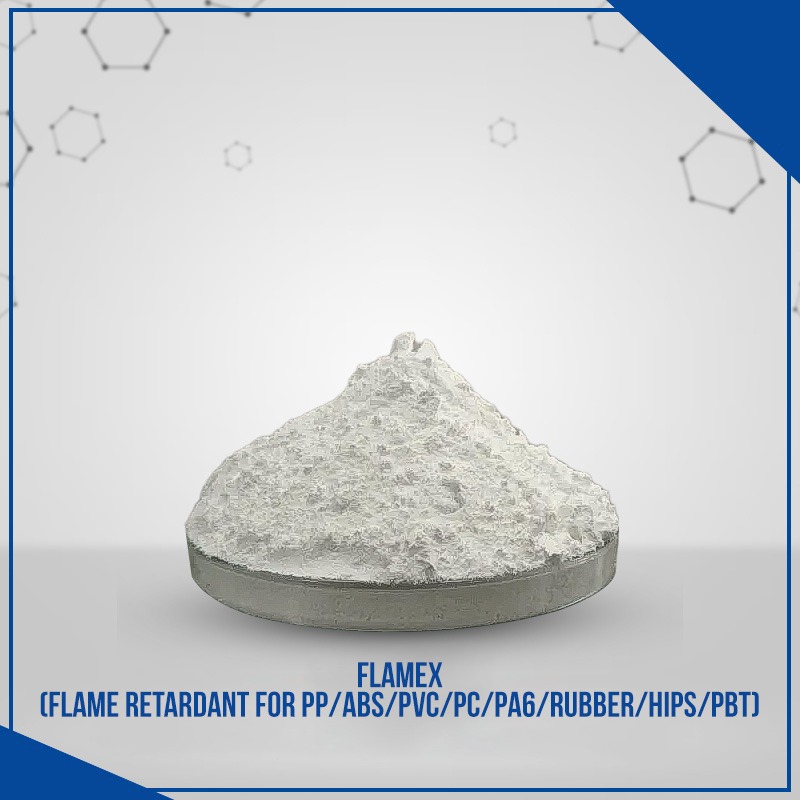 | flame retardant additives Flamex ( Flame Retardant for PP ABS PVC PC PA6 RUBBER HIPS PBT ) FLAMEX ( One Pack Flame Retardant ) manufactured by our company is widely used in PP,PA, PE,PC ,PC/ABS, PVC , Rubber ,PBT, PET, XPS, EPS, PU ,PVC,... View product → |
 | Flame Retardant Filler FAM-501 Flame Retardant Filler FAM-501 FAM - 501 Flame Retardant filler FAM-501 is One Pack Flame Retardant & Smoke Suppressant developed for Plasticized PVC applications. View product → |
Frequently asked questions
How do you match a flame retardant additive to a polymer?
Start with the resin’s melt temperature, residence time, shear conditions and wall thickness. Confirm that the additive remains stable throughout processing; do not transfer a package between polymers without a new compatibility review.
What should the first flame retardant formulation trial specify?
Define additive loading, processing temperature, residence time, mixing or shear conditions, and dispersion checks before the trial. ATH can dehydrate near 180–220°C, while magnesium hydroxide remains usable closer to 300–350°C, subject to residence time and shear.
Which trade-offs should you measure besides flame performance?
Compare fire results with tensile strength, impact resistance, appearance, processing behaviour and smoke generation. A formulation that passes a fire test but damages mechanical or visual requirements is not a finished solution.
What evidence should you request from a flame retardant supplier?
Request the exact fire-test report, smoke-test evidence, substance information and batch documentation relevant to your polymer and application. Check that the evidence identifies the tested formulation, loading and specimen thickness.
Related products
| FAM-501 ABOUT FAM - 501 FAM-501 is One Pack Flame Retardant & Smoke Suppressant developed for Plasticized PVC applications. View product → |
 | Antimony Trioxide Our range of Antimony trioxide is used mainly in flame retardant formulations for plastics, rubbers, textiles, paper and paints. View product → |
 | Zinc Borate ZINC BORATE is a highly effective multifunctional flame retardant synergist being used as a flame retardant and smoke suppressant in a wide range of... View product → |
 | Aluminium Trihydrate (ATH) is a very finely grounded product having a uniform and controlled particle size distribution. View product → |