Thank you for writing to us. One of our executive will reach back to you through your submitted medium. In case there’s an urgency, feel free to connect over WhatsApp for faster response.
Prefer calling? Dial +919310014249 (International callers) or +919310014249 (Indian callers).
ALUMINIUM TRIHYDRATE (ATH) is a very finely grounded product having a uniform and controlled particle size distribution. Aluminium Trihydrate is the most effective low-cost Flame Retardant filler and is mainly used as a FLAME RETARDANT & SMOKE SUPPRESSANT in various Plastics & Rubber Applications.
TYPICAL CHEMICAL ANALYSIS:-
PROPERTIES ANALYSIS
A1 (OH3) 99.50% Max
A12O3 64.50% Min
FE2O3 0.01% Max
SiO2 0.01% Max
Na2O (Total) 0.25% Max
TYPICAL PHYSICAL PROPERTIES:-
PROPERTIES ANALYSIS
Specific Gravity 2.40+=0.02
Loss On Ignition 34.50% Max
(1100 Deg C)
Moisture Content 0.50% Max
(105 Deg C)
Coatings Available Silane & Stearic
Average Particle Size 2.00-80.00 Mic
(d50) (As Per Grade)
MAGNESIUM HYDROXIDE is a very finely grounded product having an extremely uniform and narrow particle size distribution. It is considered as a non halogenated, environment friendly and non toxic mineral based flame retardant & smoke suppressant. It is used in various plastics & rubber applications.
The initial Decomposition Temperature of Magnesium Hydroxide is 320° C making it suitable for applications where the usage of Aluminium Trihydrate (ATH) has a limitation due to a higher polymer processing temperature of more than l 80°C.
Due to its higher Decomposition Temperature than ATH, It is being used as an effective smoke suppressant in conjunction with ATH.
TYPICAL CHEMICAL ANALYSIS:-
PROPERTIES ANALYSIS
Mg (OH2) 93.00% Min
MgO 60.0-62.0%
CaO 2.00-2.50%
SiO2 1.00-1.50%
Fe2O3 0.10-0.20%
TYPICAL PHYSICAL ANALYSIS:-
PROPERTIES ANALYSIS
Specific Gravity 2.36+=0.02
Loss On Ignition 31.00%Max Max
(1100 Deg C)
Moisture Content 0.50% Max
(105 Deg C)
Coatings Available Silane & Stearic
Average Particle Size
(d50 By Laser Diffraction
Our range of Antimony trioxide is produced from stibnite ores (antimony trisulfide) or as a by-product of lead smelting and production. Antimony Trioxide is used mainly in fire retardant formulations for plastics, rubbers, textiles, paper and paints. Further, Antimony Trioxide can be used as an additive in glass and ceramic products and as a catalyst in the chemical industry. Occupational exposure may occur during mining, processing and smelting of antimony ores, in glass and ceramics production, and during the manufacture and use of products containing antimony trioxide. Antimony trioxide and pentoxide do not react as flame-retardants directly. Antimony Trioxide are used as synergists to enhance the activity of halogenated flame-retardants by stepwise releasing the halogenated radicals to retard gas phase chain reaction of flame spread.
Applications:
Flame retardant for wide range of plastics, rubbers, paper and textiles
Catalyst in PET production
Activator in glass industry
Flocculant in Titanium Dioxide production
Paints and Adhesives industries
Pigments, Ceramic frites
Features:
In flame retarding thermoplastics, the synergistic action between halogenated flame-retardants and antimony trioxide is well known in the plastic industry
The Izod impact strength and translucency are two key properties that are diminished because of the particle size and pigmentation strength of antimony trioxide
The loss in translucency limits the range of available color choices because of the high loading required to offset the tinting effect of antimony trioxide
ALUMINIUM HYDROXIDE is a Super Fine Precipitated Special ATH. Finely Precipitated Special ATH is one of the Largest Consumed Flame Retardants & Smoke suppressants across the World by volumes in various applications. It is an environment-friendly and non-toxic mineral-based flame retardant. Large volumes of finely precipitatedATH are used in plastics and rubber compounding for imparting flame retardancy along with smoke suppression properties making it an effective smoke suppressant and flame retardant.
Its extremely uniform, controlled and narrow particle size distribution results .in improved compounding performance, better powder flowability, higher dosage capability, improved extrusion speed, and better thermal stability along with better output and finishing of the end product.
TYPICAL CHEMICAL ANALYSIS:-
PROPERTIES ANALYSIS
A1(OH)3 99.6Max
A12O3 64.5%Min
FE2O3 0.001Max
SiO2 0.001%
Na2O 0.09% Max
(Soluble)
TYPICAL PHYSICAL PROPERTIES:-
PROPERTIES ANALYSIS
Whiteness 95.00% Min
Specific Gravity 2.40+=0.02
Loss On Ignition 34.50% Max
(1100 Deg C)
Moisture Content 0.40% Max
(105 Deg C)
Bulk Density 0.40-0.45 gram/cc
(Untapped)
Sieve Analysis Nil
(at 325 Mesh)
Average Particle Size 1.7 -2.20 Mic
(d50 By Laser Diffraction)
Coating Silane/ Stearic acid
ZINC BORATE is a highly effective multifunctional flame retardant synergist being used as a flame retardant and smoke suppressant in a wide range of applications. It is an environment friendly flame retardant as it is non toxic in nature and does not generate any toxic/corrosive gases. It is used in plastics, rubber, textile, paint, adhesive, pigments and ceramic industries. Zinc Borate also replaces Antimony Trioxide & Decabromodiphenyl Ether partially (or even completely) in various plastics and rubber applications.
Zinc Borate is also known as ZB2335, Borate Flame Retardant, and Fire Break Zinc Borate.
TYPICAL CHEMICAL ANALYSIS:-
PROPERTIES ANALYSIS
ZnO Content 37.5+=1.50%
(By Weight)
B2O3 Content 48.00+=1.50%
(By Weight)
TYPICAL PHYSICAL PROPERTIES:-
PROPERTIES ANALYSIS
Appearance Fine White Powder
Specific Gravity 2.70+=0.15%
Sieve Residue
(at 325 Mesh) Nil
Loss on Ignition 14.5+=1.5%
(45 Deg C)
Moisture Content 0.40% Max
Average Particle Size
(d50 By Laser Diffraction) 20.-3.0Mic
CALCIUM BORATE is characterized as an environmentally friendly mineral based Flame Retardant Synergist developed as an alternative to Synthetic Zinc Borate in order to solve the thermal stability problem accompanied by Zinc Borate in plasticized PVC Applications, along with imparting superior Flame Retardant properties comparatively to Zinc Borate.
The Flame Retardant action of Calcium Borate is mainly based upon its high Char Forming and Glazing/ Fluxing ability in combination with endothermic decomposition (Heat-Shrink Effect) and along with its inert water content (Loss on Ignition) which is quite higher as compared to traditional Zinc Borate which gives it an edge over it.
TYPICAL CHEMICAL ANALYSIS
PROPERTIES ANALYSIS
CaO Content 32+=1.50%
(By Weight)
B2O3 Content 44+=1.50%
(By Weight) 0.30% Max
MgO
TYPICAL PHYSICAL PROPERTIES
PROPERTIES ANALYSIS
Appearance White Powder
Sieve Residue 0.10% Max
(at 325 Mesh)
Loss On Ignition 23.6+=1.50%
(450 deg C)
Moisture Content 0.40% Max
Average Particle Size 2.5-3.5 Mic
(By Laser Diffraction)
FAM - 501
Flame Retardant filler FAM-501 is One Pack Flame Retardant & Smoke Suppressant developed for Plasticized PVC applications. It is an Aluminum & Magnesium inorganic complex synergist treated with dispersing aids which results in the superior dispersion, processability and compatibility with the polymer hence imparting superior flame retardant & Smoke Suppressant properties as compared to other traditional synergists, especially in PVC. The synergy of FAM-501 has also been reported along with a high dosage of ATH in FRLS PVC Formulations.
TYPICAL SPECIFICATIONS:-
PROPERTIES ANALYSIS
Appearance White Powder
Moisture 0.40% Max
(105 deg C)
Bulk Density 0.40 - 0.45 gm/cc
(Untapped)
Specific Gravity 2.38 += 0.02
Sieve Residue Nil
(at 325 Mesh)
Average Particle 1.50-2.50 Microns
Size d50
(By Laser Diffraction)
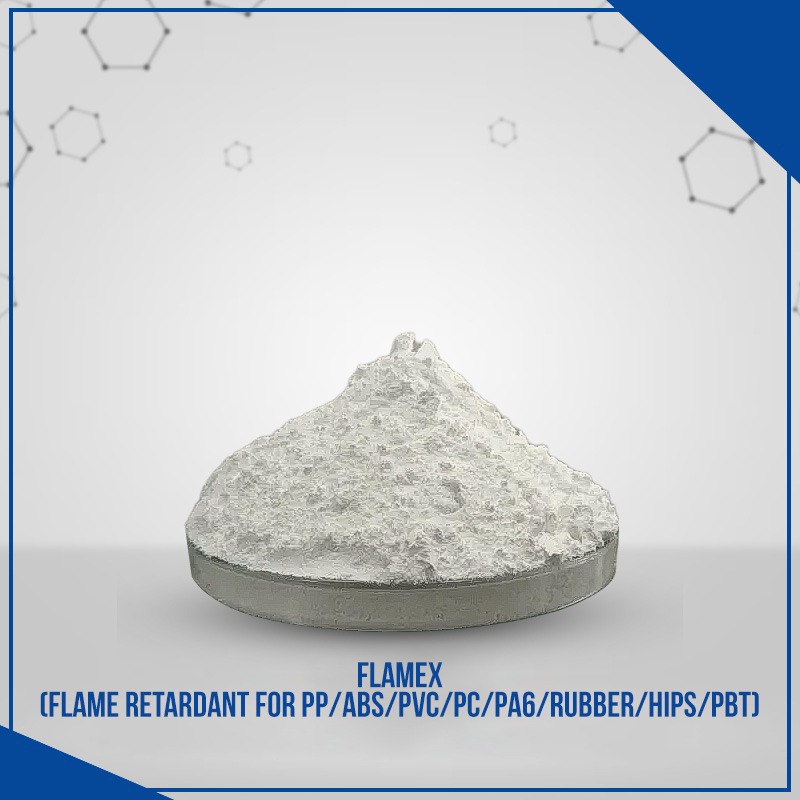
FLAMEX ( One Pack Flame Retardant ) manufactured by our company is widely used in PP,PA, PE,PC ,PC/ABS, PVC , Rubber ,PBT, PET, XPS, EPS, PU ,PVC, coating, textile include polyolefins, engineering plastics, HDPE, LDPE, PPCP, PPHP, XLPE, ABS, PBT, Nylon, Tapes, PVC, Leader Cloths, Nylon-66, EVA, PU Form, EPF Form, Textiles, Rubber, UPR . Automotive and Transportation, Building and Construction, Electrics and Electronics, Upholstery etc..
FLAMEX ( Replacement of Antimony Trioxide ) is a proprietary flame-retardant synergist developed for plasticized and rigid PVC applications as a cost effective complete replacement of Antimony Trioxide. It is an Antimony based inorganic complex synergist treated with processing and dispersion aids-which imparts superior flame retardant properties as a replacement of traditional flame-retardant synergists. Few applications include PVC Wire & Cable Compound, PVC Conveyor Belts, PVC Leather Cloth, PVC Calendaring sheets, PVC Tubing. PVC Cladding, PVC Hoses etc .
FLAMEX is a proprietary one pack flame retardant synergist treated with processing & dispersion aids which imparts superior flame retardant properties as compared to traditional flame retardant synergists. It can meet the required UL standard and achieve the V0, V1, V2 flammability rating.
We have various grades of FLAMEX which are HALOGEN FREE or halogen containing also as per requiremts in which polymer it has to be used and what properties of final product is required.
Various applications of FLAMEX include polyolefins, engineering plastics, HDPE, LDPE, PPCP, PPHP, XLPE, ABS, PBT, Nylon, Nylon-66, EVA, Rubber, UPR etc.
MOLYBDENUM TRIOXIDE is a high purity free flowing powder and is the most effective Smoke Suppressant used in a variety of applications.
Molybdenum Trioxide is used in various formulations in order to achieve reduced smoke levels along with a high level of flame retardancy, especially in rigid and flexible PVC applications.
TYPICAL CHEMICAL ANALYSIS:-
PROPERTIES ANALYSIS
Assay as (Mo03) 99.5% Min
Molybdenum (Mo) 66.0% Min
Alkalis (Na + K) 0.02% Max
Copper (Cu) 0.02% Max
Silica (Si) 0.01% Max
TYPICAL PHYSICAL PROPERTIES:-
PROPERTIES ANALYSIS
Specific Gravity 4.70+0.20
Sieve Residue 0.10%Max
(at 325 Mesh)
Moisture Content 0.40%Max
(105 degrees Celsius)
Average Particle Size 0.01%Max
(d50 By Laser Diffraction)
Molybdenum Trioxide
Still searching for the alumina trihydrate manufacturers?