
A flame-retardant additive changes how a plastic ignites, burns, releases heat or produces smoke, but it does not make the polymer non-combustible. By the end, you will be able to distinguish additive types, match them to resins and processing conditions, and specify the tests and supplier evidence needed before approving a formulation.
Key takeaways
- Flame retardants alter burning behaviour; they do not make plastic non-combustible.
- Match the additive package to the resin, temperature and compounding process.
- Test high loadings for changes in strength, flow, appearance and long-term stability.
- Qualify suppliers through batch records, technical data and formulation-scale testing.
What a flame-retardant additive actually does in a plastic
A flame-retardant additive is blended into plastic to change how it burns; it does not make the polymer non-combustible. Depending on its chemistry, it provides delayed ignition, slows flame spread, lowers the heat-release rate, promotes a protective char layer, or interrupts combustion chemistry in the gas phase.
These effects are different. A plastic can ignite later yet burn intensely once ignited, or self-extinguish while releasing substantial heat before extinction. Smoke suppression is a separate objective: reducing smoke does not automatically stop flames, and flame extinction does not guarantee low smoke.
UL 94 V-0 is a small-specimen vertical-burning classification, not building-fire approval. Each of ten flame applications must produce no more than 10 seconds of afterflame, total afterflame must not exceed 50 seconds, and flaming drips must not ignite the cotton indicator.
| Test | What it measures | What it cannot establish |
|---|---|---|
| UL 94 | Vertical burning and afterflame behaviour | Building approval, heat release or smoke density |
| ASTM D2863 LOI | Oxygen concentration supporting burning | Real-fire heat release or smoke |
| ISO 5660-1 | Ignition, heat-release rate, mass loss and smoke under radiant flux | A simple pass/fail product rating |
| ASTM E662 | Smoke obscuration under flaming and non-flaming conditions | Flame-retardance classification |
Thickness, specimen orientation, colour, processing history, molding conditions and preparation alter results. Test production-grade specimens at each target thickness; a V-0 result at one thickness does not cover every geometry.
Additive, reactive flame retardant, filler and synergist: which mechanism are you buying?
A physically blended additive sits in the polymer without bonding to its chains, so it can migrate, bloom or be extracted by heat, oil, humidity or cleaning agents. A reactive flame retardant bonds into the polymer, improving permanence while potentially changing molecular weight, viscosity, cure chemistry and recyclability.
| Option | Mechanism and role | Main trade-offs |
|---|---|---|
| Halogenated flame retardant | Gas-phase radical trapping; antimony trioxide can act as a synergist by forming volatile antimony-halogen species | Strong flame performance, but smoke, toxicity, corrosion, regulatory and density concerns; antimony trioxide alone does not reproduce halogen-antimony synergy |
| Phosphorus or intumescent system | Condensed-phase char formation; a conventional intumescent needs an acid source, carbon source and blowing source | Lower smoke is possible, but moisture, dispersion and processing stability affect char; phosphorus packages can affect colour, hydrolysis resistance and electrical tracking |
| Mineral hydroxide filler | Absorbs heat and releases water; aluminium hydroxide and magnesium hydroxide dilute fuel | Low toxicity and smoke potential, but high loading raises density and viscosity and lowers elongation |
| Zinc borate synergist | Strengthens char or mineral-based flame-retardant action | Useful in a package, not a complete formulation; it adds cost and can alter colour and electrical properties |
| Smoke suppressant | Targets smoke generation separately from flame extinction | It cannot substitute for flame protection; evaluate smoke under flaming and non-flaming conditions |
Match the package to the resin, thickness and process. Compare flame performance against smoke, toxicity, corrosion, density, cost, permanence, migration, bloom, extraction, recyclability and processing stability; a formulation that passes a small-flame test can still release high heat in a larger fire.
How to match the package to the resin and compounding process
Match the additive to the resin before choosing its flame rating: polymer compatibility, processing temperature, moisture sensitivity, melt viscosity, colour, electrical insulation and tracking performance determine whether a package survives production.
1. Screen the resin first. PP, PE, HIPS and rubber need packages that disperse without excessive viscosity or blooming. ABS and PVC need colour and thermal-stability checks. PC, PC/ABS and PA6, PBT, PET and other engineering plastics need hydrolysis, moisture and residence-time control. Dry hygroscopic resins and hygroscopic additives to the supplier’s specified moisture level.
2. Compare the thermal window with the additive. ATH begins endothermic decomposition around 180–200 °C and releases water, making it suitable for lower-temperature compounds. Magnesium hydroxide is commonly used around 300–350 °C and suits some higher-temperature processes.
Either can fail when melt temperature, residence time or venting is poorly controlled: ATH can decompose prematurely, while magnesium hydroxide can disperse poorly or overload the melt.
3. Start formulation trials at roughly 20–40 wt% for many mineral-hydroxide systems, 10–25 wt% for some synergist packages, or lower levels when using a concentrated masterbatch. These are development ranges, not guarantees.
Add the carrier and resin first, introduce powders through a controlled feed, then dilute the masterbatch; use twin-screw dispersion, suitable kneading, moderate residence time and continuous melt-temperature monitoring. Test tensile, impact, colour, flow, insulation and tracking before approval.
What high additive loading changes in the finished part
High additive loading can change the part more than the base resin does. Poor dispersion creates agglomerates that reduce tensile strength, impact strength and elongation, weaken weld lines and produce uneven hardness.
High mineral loading raises specific gravity and viscosity, reduces melt flow, increases moulding pressure, and can cause rough surface finish, colour streaks and visible flow marks.
Phosphorus packages can alter hydrolysis resistance in moisture-sensitive resins, promote corrosion at metal contacts, shift colour during processing or aging, and reduce long-term electrical tracking performance. They can also complicate recycling because repeated heat histories change the package and the polymer together.
A formulation that achieves UL 94 V-0 on a small specimen can still release high heat flux in a larger fire; self-extinguishing is not the same as low heat release.
Use production-grade molded specimens and check:
- Tensile strength, impact strength, elongation, hardness, melt flow, specific gravity, colour, surface finish and weld-line strength after conditioning and thermal aging.
- UL 94 V-0 at every target thickness; use ASTM D2863 LOI only as supporting evidence, not as a fire-performance prediction.
- ISO 5660-1 cone calorimetry for ignition time, heat-release rate and total heat release, plus ASTM E662 for flaming and non-flaming smoke obscuration.
- Migration, bloom, oil exposure, humidity, cleaning-agent exposure, thermal aging, electrical insulation and tracking.
- Regrind trials to measure recyclability, dispersion, colour shift and mechanical-strength loss.
How Delhi manufacturers should qualify a formulation and its supplier
Treat supplier qualification as a production decision, not a catalogue review. For Delhi plastic manufacturers and export compliance, screen each substance against its intended polymer, product and destination market; “halogen-free” is not a regulatory conclusion. Check older brominated packages such as decabromodiphenyl ether (decaBDE), which is listed under the Stockholm Convention on Persistent Organic Pollutants.
Ask the supplier for:
- Exact chemical identity, halogen status, recommended polymer grades and dosage range
- Decomposition or processing-temperature data, moisture specification and particle-size distribution
- Safety data sheet, certificate of analysis, batch number and storage life
- Test reports using the same compound, specimen thickness and processing route you will produce
Compare packages on the same formulation basis:
| Option | Compare | What can go wrong |
|---|---|---|
| One-pack flame retardant | Total loading, dispersion, density, smoke, cost and repeatability | A convenient blend can hide incompatible components or increase loading |
| Base flame retardant plus antimony trioxide | Separate dosing, density, smoke and material cost | Dosing error or poor dispersion can change performance; antimony trioxide alone does not recreate halogen-antimony synergy |
| Base flame retardant plus zinc borate | Total loading, smoke, char, density and repeatability | Moisture, particle-size variation or inadequate mixing can produce inconsistent parts |
Niknam Chemicals Pvt. Ltd can be included in a Delhi supplier comparison, but independent formulation trials, batch records and test evidence—not a product label—decide suitability.
Related products
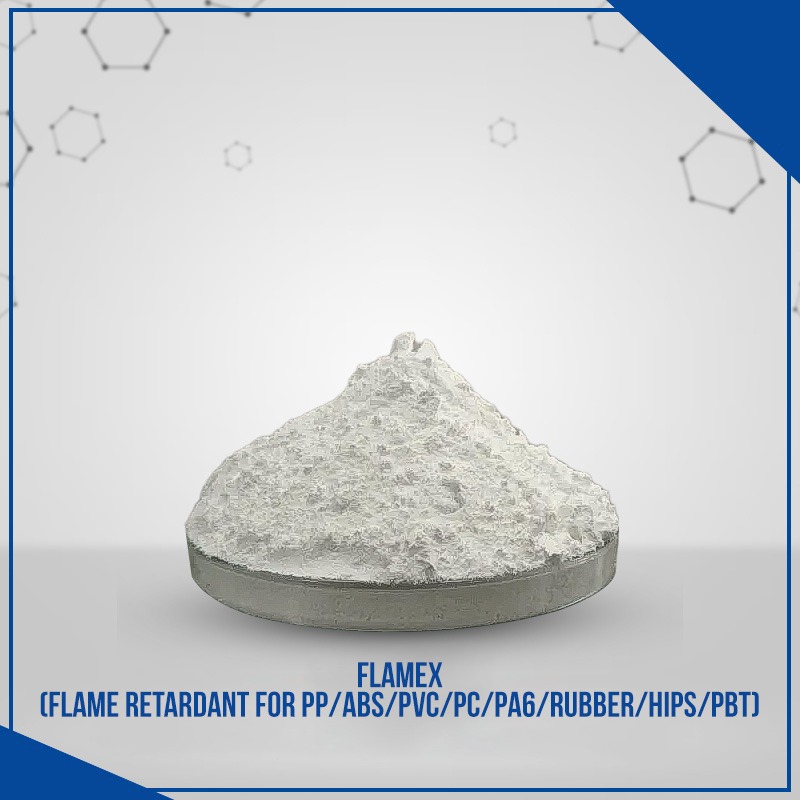 | flame retardant additives Flamex ( Flame Retardant for PP ABS PVC PC PA6 RUBBER HIPS PBT ) FLAMEX ( One Pack Flame Retardant ) manufactured by our company is widely used in PP,PA, PE,PC ,PC/ABS, PVC , Rubber ,PBT, PET, XPS, EPS, PU ,PVC,... View product → |
 | Flame Retardant Filler FAM-501 Flame Retardant Filler FAM-501 FAM - 501 Flame Retardant filler FAM-501 is One Pack Flame Retardant & Smoke Suppressant developed for Plasticized PVC applications. View product → |
Frequently asked questions
What does a flame-retardant additive do in plastic?
It can delay ignition, slow flame spread, reduce heat release, form protective char or interrupt gas-phase combustion, depending on its chemistry.
What is the difference between an additive, reactive flame retardant, filler and synergist?
An additive disperses through the polymer without chemically bonding; a reactive flame retardant bonds into the polymer; a filler changes the physical formulation; and a synergist improves the performance of another flame retardant.
How do you match a flame-retardant package to a plastic resin?
Check compatibility with the resin, processing temperature, shear conditions, moisture sensitivity, target loading and the finished part’s required fire performance.
What should Delhi plastic manufacturers check when qualifying a supplier?
Request a technical data sheet, safety data sheet, batch identification, specification limits and test evidence, then confirm performance through trials in your own resin and process.
Related products
| FAM-501 ABOUT FAM - 501 FAM-501 is One Pack Flame Retardant & Smoke Suppressant developed for Plasticized PVC applications. View product → |
 | Antimony Trioxide Our range of Antimony trioxide is used mainly in flame retardant formulations for plastics, rubbers, textiles, paper and paints. View product → |
 | Zinc Borate ZINC BORATE is a highly effective multifunctional flame retardant synergist being used as a flame retardant and smoke suppressant in a wide range of... View product → |
 | Aluminium Hydroxide ALUMINIUM HYDROXIDE is a Super Fine Precipitated Special ATH. View product → |