
Polypropylene does not naturally provide a large fire-safety margin: its limiting oxygen index is about 18%, below the 20.9% oxygen concentration in air, and burning PP can soften and drip. By the end, you will be able to match an additive package to the PP grade, set a realistic loading and processing plan, and request test evidence that applies to your actual part thickness and end use.
Key takeaways
- Match additives to PP crystallinity, rubber content, melt strength, and impact grade.
- Set loading and let-down ratios before comparing cost per kilogram.
- Test flame and smoke performance at the finished product’s actual thickness.
- Specify dosage, processing limits, test methods, and documentation in every Delhi RFQ.
Match the flame-retardant package to the polypropylene grade
Crystallinity, rubber content, melt strength and impact requirements determine the package. Compare the grade before comparing additives.
| Grade | Structure and behaviour | Flame-retardant implication |
|---|---|---|
| homopolymer PP (PPHP) | High crystallinity, stiffness and heat resistance; lower impact than copolymer grades | Supports char formation and melt strength, but needs impact retention |
| random copolymer PP | Ethylene units reduce crystallinity and stiffness; improved clarity and impact | Softer melt can drip sooner, weakening vertical-burning performance |
| impact copolymer PP (PPCP) | Rubber phase improves impact resistance but lowers crystallinity and melt strength | Rubber promotes dripping and demands stronger char or anti-drip control |
A halogen-free intumescent system normally combines an acid source such as ammonium polyphosphate, a carbon source and a blowing source. One additive cannot automatically reproduce that complete reaction: omit a component or disperse it poorly and the char becomes thin, discontinuous and easy to break.
PP can soften and drip before the char protects the specimen, so a good limiting-oxygen-index result does not guarantee a passing vertical-burn test.
Magnesium hydroxide decomposes around 300–350 °C; aluminium hydroxide releases water around 180–220 °C and can interfere with ordinary PP processing. Magnesium hydroxide suits higher-temperature processing but requires heavy mineral loading. Zinc borate can suppress smoke and support char, yet its effect is package-specific.
Qualify every formulation separately with glass fibre, talc, calcium carbonate, pigments and nucleating agents. They alter heat conduction, viscosity, dripping, char continuity and additive dilution; a concentrate proven in unfilled PP is not proven in filled PP.
Set loading, let-down and property trade-offs before compounding
For conventional ammonium-polyphosphate intumescent systems targeting UL 94 V-0, start formulation trials around 20–30 wt% loading for the total package. Do not treat a low-dose claim as universal: verify the PP grade, wall thickness, package composition and test report.
1. Convert every supplier recommendation to finished-compound weight percent. Weight percent means additive mass divided by total compound mass; phr means parts of additive per 100 parts of resin; a masterbatch let-down ratio states how much concentrate is blended with neat PP.
A 30% masterbatch added at 10% let-down does not produce 30 wt% additive in the finished compound.
2. Budget for losses from high mineral or phosphorus loading: tensile strength, elongation, impact resistance and melt flow can fall. Density, colour, odour, torque, throughput, mould filling, weld-line strength and surface finish can change as well.
Require melt-flow rate (MFR) data from the finished flame-retardant compound after the intended drying and processing history, not from neat PP alone.
3. Qualify recycled PP separately. Contamination, prior thermal history, variable MFR and moisture can change dripping and vertical-burning results, so a virgin-PP approval does not transfer automatically.
4. Anti-drip behaviour is not free. Excessive char formation or crosslinking can stop dripping while producing brittle parts, lower impact resistance and weaker weld lines. Balance vertical-burning performance against the mechanical properties your part must retain.
Build the additive into PP without losing thermal or processing control
Do not set a PP temperature profile from the resin datasheet alone. Obtain the additive’s physical form, particle-size distribution, bulk density, moisture content, carrier-resin identity, and decomposition or melt-temperature data first.
1. Dry moisture-sensitive powders to the supplier’s specified limit, then sieve out agglomerates. Condition the PP resin and compatible carrier consistently so feeder output does not fluctuate.
2. In twin-screw extrusion, feed resin and carrier steadily, then introduce the additive through a side feeder when downstream addition protects it from early heat exposure. Use enough distributive mixing for uniform concentration and enough dispersive mixing to break agglomerates; excessive shear or residence time can damage the package.
3. Require the supplier to define feed-zone temperatures, maximum melt temperature, screw-speed range, residence-time window, and recommended screen pack. Monitor torque, melt pressure and throughput during the trial; rising torque or falling output signals poor flow, agglomeration or degradation.
4. Validate injection moulding, compression moulding and masterbatch production separately. Shear, back pressure, cooling rate and wall thickness change dispersion, mould filling, weld lines and flame-retardant dripping, so a successful extrusion trial does not qualify every process.
5. Compare moulded parts with unmodified PP for mould filling, weld lines, surface defects, odour and colour, alongside torque, pressure and throughput records. Do not treat stability at normal PP processing temperatures as proof of stability after prolonged residence or repeated recycling.
Read fire and smoke test results at the thickness you will sell
Approve a fire claim only when the report matches the part thickness, orientation and conditioning you will sell. At the usual 0.8 mm specimen thickness, UL 94 ratings mean:
| Rating | Afterflame limits | Flaming drips |
|---|---|---|
| UL 94 V-0 | Each application: 10 seconds; total: 50 seconds | Not permitted to ignite cotton |
| UL 94 V-1 | Each application: 30 seconds; total: 250 seconds | Must not ignite cotton |
| UL 94 V-2 | Each application: 30 seconds; total: 250 seconds | Permitted if they ignite cotton |
IEC 60695-11-10 provides 50 W horizontal and vertical flame methods, while IEC 60695-11-20 uses a 500 W flame. ASTM D635 measures horizontal burning; ASTM D2863 measures limiting oxygen index. These tests answer different questions, so do not substitute an oxygen-index result for a vertical-burning classification.
UL 94 does not establish low smoke, heat release or glow-wire performance. Request ASTM E662 optical smoke density in flaming and non-flaming modes, or ASTM E1354/ISO 5660 cone-calorimeter data recorded at a stated heat flux, including ignition time, heat-release rate and total heat release.
For electrical products, obtain separate IEC 60695 glow-wire evidence. A glow-wire result does not replace UL 94 material classification.
Every report must identify:
- Specimen thickness, orientation, conditioning and ageing
- PP grade, filler content and additive loading
- Test method, heat flux where applicable, and complete result
A V-0 result at 0.8 mm does not prove performance at a thicker or thinner finished wall.
Write a Delhi procurement specification that suppliers can actually answer
Approve an additive only against a completed supplier comparison sheet for the exact PP formulation, not against a generic V-0 claim.
1. Require the supplier technical data sheet and certificate of analysis to complete these fields:
| Field | Required entry |
|---|---|
| Exact PP grade | Homopolymer, random copolymer, impact copolymer, PPCP or PPHP; resin grade and MFR |
| Finished loading | Additive wt% in compound, phr, and masterbatch let-down |
| Physical supply | Powder, pellet or concentrate; carrier resin; particle-size distribution; bulk density |
| Handling | Moisture content; recommended drying temperature and time; storage life |
| Finished compound | MFR after drying and processing; density; ash; colour; odour |
| Performance | Electrical insulation data; tensile, elongation and impact retention versus neat PP |
2. Request a formulation-specific certificate or report naming the UL 94, IEC 60695, ASTM or ISO method, specimen thickness, orientation, conditioning protocol, PP grade, loading and result. Reject “V-0” or “smoke reduction” statements that omit loading or thickness.
For humid storage or outdoor use, ask whether ammonium polyphosphate is coated or surface-treated, then require water uptake and post-conditioning flammability.
3. Require a destination-market substance declaration. EU RoHS Annex II restricts PBB and PBDE to 0.1% by homogeneous material; it does not ban every halogen-containing chemistry.
Include Niknam Chemicals Pvt. Ltd in the comparison as a source to contact for PP-specific grade, loading, processing and test documentation, while treating published product-family information as a starting point, not qualification evidence.
Related product
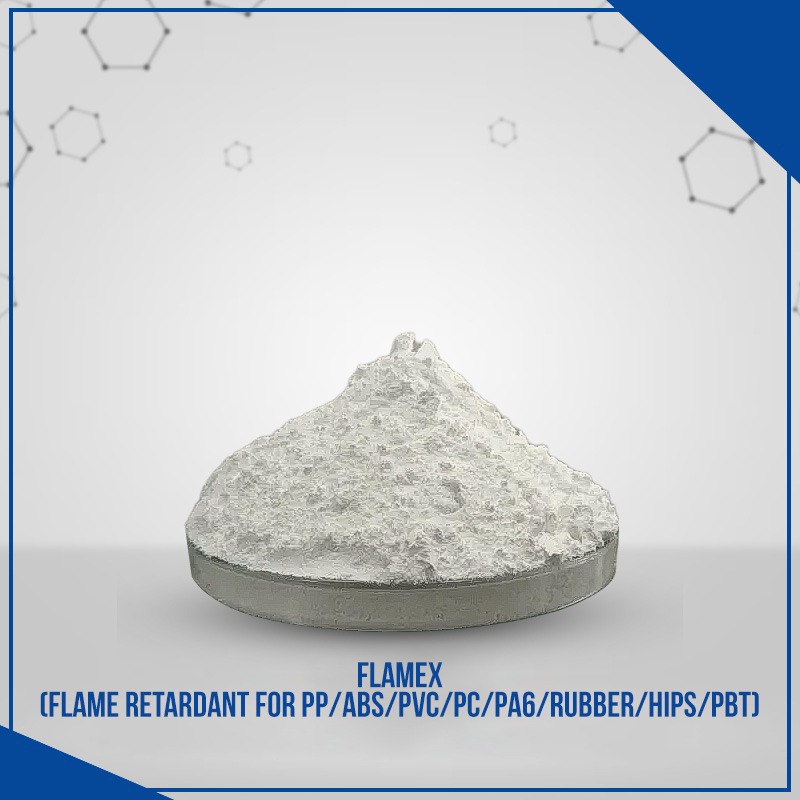 | flame retardant additives Flamex ( Flame Retardant for PP ABS PVC PC PA6 RUBBER HIPS PBT ) FLAMEX ( One Pack Flame Retardant ) manufactured by our company is widely used in PP,PA, PE,PC ,PC/ABS, PVC , Rubber ,PBT, PET, XPS, EPS, PU ,PVC,... View product → |
Frequently asked questions
How do you match a flame-retardant package to a polypropylene grade?
Compare crystallinity, rubber content, melt strength, impact requirements, and processing conditions before selecting additives.
What should you set before compounding flame retardants into PP?
Set additive loading, let-down ratio, target fire rating, colour, impact strength, stiffness, density, and acceptable processing trade-offs.
How can you add flame retardant to PP without losing processing control?
Control drying, feeder accuracy, melt temperature, residence time, dispersion, torque, and venting during compounding.
Why must fire and smoke results be read at the finished thickness?
Flame spread, smoke generation, dripping, and self-extinguishing behaviour change with specimen thickness and product geometry.
What belongs in a Delhi procurement specification for PP flame retardants?
State the PP grade, additive chemistry or performance target, dosage range, test standards, thickness, processing limits, batch documents, and delivery requirements.