
A UL 94 V-0 claim is meaningful only when you know which polymer, formulation, colour, specimen thickness, conditioning route and test procedure produced it. By the end, you will be able to interpret the rating, prepare a representative formulation, and specify evidence that applies to the plastic part you intend to manufacture in Bengaluru.
Key takeaways
- Treat HB as different from vertical V-0, V-1 and V-2 classifications.
- Check specimen thickness, orientation and conditioning before comparing UL 94 results.
- Do not treat a UL 94 rating as finished-product fire-safety approval.
- Request the test report, polymer grade, thickness and formulation traceability before accepting V-0 material.
What UL 94 ratings actually measure
UL 94 measures how a specified plastic specimen burns under a controlled flame, not how a finished product behaves in a fire. HB is a horizontal classification; V-0, V-1 and V-2 are vertical classifications. Because the exposure and pass criteria differ, HB is not an equivalent substitute for V-0.
| Classification | What it measures | Key distinction |
|---|---|---|
| UL 94 HB | Horizontal burning | The specimen must burn below a permitted rate or stop before reaching the 100 mm mark. It does not assess vertical self-extinguishing. |
| UL 94 V-2 | Vertical burning | After flame application, burning must stop within the V-1 time limits, but flaming drips are allowed to ignite the cotton indicator below the specimen. |
| UL 94 V-1 | Vertical burning | Burning must stop within longer permitted times than V-0, and flaming drips must not ignite the cotton indicator. |
| V-0 | Vertical burning | Burning must stop within the shortest permitted times, with no flaming drips igniting the cotton indicator. |
The V-2 versus V-1 distinction matters above wiring, connectors or combustible surfaces: a dripping specimen can transfer ignition even when its flame duration meets the vertical limit. V-0 is therefore not simply a stronger label for every use; the required class depends on the construction and hazard.
A rating also belongs to the tested thickness and resin grade. Specify the minimum wall thickness and exact material identity, not merely “UL 94 V-0 plastic.” For export products, compare the UL 94 result with the destination product standard, which can demand assembly-level testing.
How specimen orientation, thickness and conditioning change the result
A UL 94 result belongs to a defined specimen, not to a resin universally. In the vertical burning test, the laboratory mounts a 125 mm specimen with a 13 mm specimen width in the prescribed position and applies a controlled flame twice.
It records afterflame time, afterglow time, and whether flaming drips ignite cotton beneath the specimen. The reported classification is calculated across five specimens: V-0 permits a cumulative afterflame time of 50 seconds, while V-1 and V-2 permit 250 seconds; the vertical class also applies separate limits to individual flames, afterglow and dripping.
The horizontal burning test uses a different orientation, flame exposure and acceptance calculation. Its HB result cannot replace a vertical V classification for a part whose design requires vertical-burning performance.
Thickness changes the heat path and the amount of polymer available to burn. A formulation that achieves V-0 at a thick wall can receive a lower classification, or none, at a thinner wall. Record the tested nominal thickness, then compare it with the production wall.
Conditioning changes moisture, volatile content and polymer behaviour before ignition. Verify the report’s conditioning sequence, material designation, colour and specimen preparation. Injection-moulding temperature, fibre direction, weld lines, pigmentation, moulded skin and regrind can also change burning behaviour. Transfer the result only when the production formulation and test arrangement match the certified specimen.
Why a UL 94 result is not a finished-product fire-safety approval
A UL 94 material flammability classification proves that a specified plastic specimen, at a stated thickness and conditioning route, behaved within the standard’s small-scale burn limits. It does not certify the part made from that plastic, much less the appliance or enclosure containing it.
| Evidence | What it establishes | What it leaves unanswered |
|---|---|---|
| UL 94 classification | Specimen afterflame, afterglow and burning-drip behaviour under the prescribed flame exposure | Flame spread across a product, fire growth, heat release rate or performance under a real electrical fault |
| Smoke testing | Smoke density and, where tested, smoke composition or toxicity | Whether the plastic earns V-0; smoke suppression and flame resistance address different measurements |
| Finished enclosure testing | Behaviour of the assembled enclosure with its openings, joints, barriers and components | Whether an isolated plaque passes UL 94 |
Product certification can add enclosure dimensions, creepage and clearance, ignition sources, abnormal operation, temperature rise and component interactions. A V-0 plaque does not show that a short circuit will avoid ignition, that a hot terminal will not melt a wall, or that flames will not spread across an assembly.
For a Bengaluru-made appliance, cable assembly or switchgear enclosure, request the destination product standard and its construction-level test plan. Treat UL 94 as input to finished enclosure testing, not as the approval itself.
How to qualify a flame-retardant formulation for the polymer you actually use
Do not transfer a V-0 dosage from PP to ABS or PC/ABS. The resin, melt temperature, glass-fibre content and moulding history can change both burning behaviour and mechanical performance, so qualify the additive in each production-intended combination.
1. Fix the baseline. Record the exact polymer grade, polymer moisture, recycled-content percentage, pigment, impact modifier, glass-fibre level, target wall thickness, screw design, melt temperature, residence time and moulding cycle.
2. Build a dosage ladder for each resin system. Include the supplier’s proposed flame-retardant dosage, one lower level and one higher level, reporting each as weight percent of the total compound.
Select the lowest loading that meets the required UL 94 class at the specified thickness without unacceptable loss of impact strength, melt flow, colour or surface quality.
3. Compound and mould plaques using production-representative equipment. A laboratory blend cannot expose the same dispersion, shear, drying and residence-time effects as an injection-moulding line. Dry hygroscopic grades such as PC/ABS according to the resin supplier’s instructions; excess moisture can cause voids and weaken specimens.
4. Test plaques made with the intended process, orientation and wall thickness. Compare after changing additive supplier, dosage, polymer grade, glass-fibre content or moulding conditions; each change can invalidate the earlier result.
5. Keep formulation and process records with the test report. Niknam Chemicals Pvt. Ltd can be included in a comparative trial, but judge the formulation by its tested resin grade, dosage and process—not by the additive name alone.
Related products
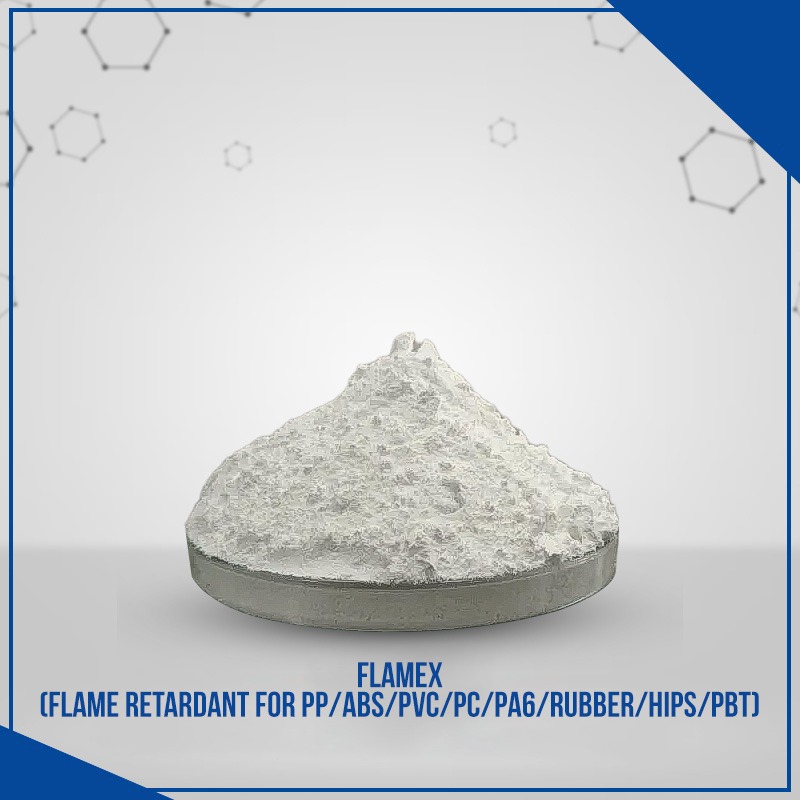 | flame retardant additives Flamex ( Flame Retardant for PP ABS PVC PC PA6 RUBBER HIPS PBT ) FLAMEX ( One Pack Flame Retardant ) manufactured by our company is widely used in PP,PA, PE,PC ,PC/ABS, PVC , Rubber ,PBT, PET, XPS, EPS, PU ,PVC,... View product → |
 | Flame Retardant Filler FAM-501 Flame Retardant Filler FAM-501 FAM - 501 Flame Retardant filler FAM-501 is One Pack Flame Retardant & Smoke Suppressant developed for Plasticized PVC applications. View product → |
What to request before accepting a V-0 material in Bengaluru
A supplier’s “UL 94 V-0” claim is usable only when the certificate or UL 94 test report identifies the same compound you will mould, at the same minimum wall thickness. Ask for these records and compare each field:
| Item | Compare against your production requirement | Investigate or reject when |
|---|---|---|
| Material designation and colour | Exact grade, colour code and additive package | The document names only a polymer family or omits colour |
| Resin grade versus compounded formulation | Production-intended resin, flame-retardant loading and glass-fibre content | The evidence covers a different formulation, higher loading or unfilled resin |
| Nominal thickness | Your thinnest production wall, not just the plaque thickness | V-0 is reported only at a thicker specimen |
| Specimen preparation | Moulding method, specimen orientation and preparation details | The supplier cannot show how specimens were made |
| Conditioning | 23 ± 2 °C and 50 ± 5% relative humidity for 48 hours, plus any heat-ageing route | The conditioning route is missing or differs from your required evidence |
| Traceability | Report number, certification record, manufacturer, grade and revision | A changed additive supplier, polymer grade, loading or process has no new record |
Do not treat a generic datasheet as part approval. Request the complete UL 94 test report or certification record, then match it to your purchase order, approved colour, minimum wall thickness and production process.
For export, add the destination product standard to the specification. UL 94 classifies the material; it does not replace the enclosure or assembly requirements for spacing, ignition sources, abnormal operation or finished-product certification. A V-0 plaque can therefore be acceptable evidence for material control and still be insufficient for the shipment.
Frequently asked questions
What does UL 94 testing measure?
UL 94 measures how a specified plastic specimen burns under a controlled flame. HB is horizontal, while V-0, V-1 and V-2 are vertical classifications with different exposure and pass criteria.
Why do specimen thickness and conditioning affect UL 94 results?
A material’s rating applies to the tested specimen dimensions and conditioning. Changing thickness, orientation or moisture and temperature conditioning can change ignition, burning time and dripping behaviour.
Does a UL 94 V-0 result approve a finished product?
No. UL 94 evaluates a plastic specimen, not the complete product. Product approval also depends on construction, enclosure design, electrical risks, end-use conditions and the applicable product standard.
How do you qualify a flame-retardant formulation for a polymer?
Test the complete formulation in the polymer grade, colour, thickness and processing conditions used in production. Confirm mechanical, thermal, electrical, smoke and processing performance alongside UL 94 results.
What should you request before accepting a V-0 material in Bengaluru?
Request the UL 94 test report, standard and edition, specimen thickness, orientation, conditioning details, polymer grade, colour, batch or formulation identification and evidence that production material matches the tested formulation.
Related products
| FAM-501 ABOUT FAM - 501 FAM-501 is One Pack Flame Retardant & Smoke Suppressant developed for Plasticized PVC applications. View product → |
 | Aluminium Trihydrate (ATH) is a very finely grounded product having a uniform and controlled particle size distribution. View product → |
 | Zinc Borate ZINC BORATE is a highly effective multifunctional flame retardant synergist being used as a flame retardant and smoke suppressant in a wide range of... View product → |
 | Aluminium Hydroxide ALUMINIUM HYDROXIDE is a Super Fine Precipitated Special ATH. View product → |